Selecting the right overhead crane system is one of the most critical decisions an industrial facility can make. Whether you operate in steel fabrication, manufacturing, municipal utilities, aerospace, or equipment maintenance, the right lifting equipment will have a positive impact on safety, productivity, and operational longevity.
Industry standards bodies—including the Crane Manufacturers Association of America (CMAA), ASME, and OSHA—have weighed in on the topic. They consistently emphasize that proper crane selection begins with an engineering‑driven evaluation of load requirements, duty cycle, operating environment, and building constraints.
Below is an updated guide that integrates these principles with practical field experience to paint a clear picture of which overhead cranes are best suited for different types of work.
Common Types of Overhead Cranes
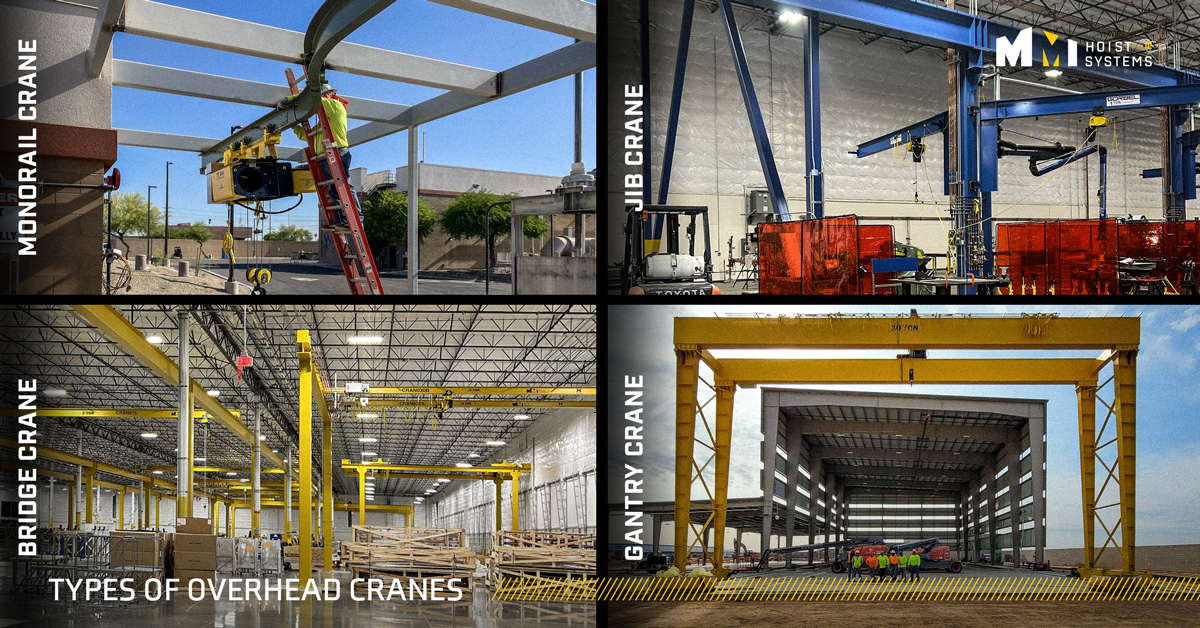
1. Bridge Cranes
Best for: Manufacturing, steel processing, aerospace, and high‑volume industrial operations.
Bridge cranes travel along runway beams with a hoist that moves across a horizontal bridge. Because they are so versatile, they are one of the most widely used crane systems in industrial environments.
Common configurations include:
- Single‑girder (more economical, lower capacity, for lighter-duty applications)
- Double‑girder (greater lift height, higher capacity, better performance for heavy-duty cycles)
CMAA Specifications 70 (top‑running cranes) and 74 (under‑running cranes) define the engineering requirements for these systems, including structural design criteria, service classifications, and performance expectations. These specifications ensure that cranes match the actual duty cycle of the facility, so they can operate safely and efficiently.
2. Gantry Cranes
Best for: Outdoor yards, construction sites, precast concrete, shipyards, and facilities without structural runway support.
Gantry cranes are supported by legs instead of overhead runways, making them more flexible and portable. This makes these systems ideal for temporary or changing environments.
These systems are governed by OSHA 1910.179 safety requirements and ASME B30.2 structural/operational guidelines to ensure safety and stability.
3. Jib Cranes
Best for: Workstations, machining, assembly lines, and repetitive localized lifting
Jib cranes provide rotational movement (180°–360°) and are often integrated with larger overhead crane systems. Simple and efficient, they are ideal for repetitive, task-specific lifting.
ASME B30.11 outlines design and safety requirements for jib cranes, ensuring proper selection of slewing bearings, hoists, and anchoring structures.
4. Monorail Cranes
Best for: Linear workflows such as paint booths, assembly lines, and production cells
Monorail systems move loads along a fixed path that can include curves, switches, and elevation changes. This makes them highly customizable, and a good choice for process‑specific movement.
The Material Handling Industry (MHI) research highlights monorail systems as one of the most adaptable solutions in modern manufacturing, particularly where repeatability and consistency are required.
Engineering Factors to Consider When Selecting a Crane
1. Load Capacity & Duty Cycle
A lifting system may have a Class C, D, or E rating, depending on lifting frequency, load weight, and operational intensity. CMAA standards emphasize that selecting a crane without understanding duty class is one of the leading causes of premature wear.
For example, heavy fabrication shops, steel mills, and equipment maintenance facilities often require Class D or E cranes due to continuous operation and high-impact loading.
2. Facility Layout or Structural Constraints
Building conditions can have a significant impact on crane selection.
- Facilities with a low ceiling clearance often benefit from under-running cranes (CMAA 74).
- Facilities without runway columns may need to use freestanding or gantry systems.
- Outdoor or corrosive environments often require stainless components or NEMA-rated enclosures, per ASME B30 guidelines.
3. Workflow and Material Movement
Engineering News-Record (ENR) notes a growing trend toward system-specific material handling, where crane systems are designed as integrated parts of the workflow.
For example, if material flow is linear, a monorail will likely outperform a bridge crane in both cost and efficiency.
4. Safety and Regulatory Compliance
OSHA 1910.179 establishes foundational safety requirements for overhead and gantry cranes, including:
- Frequent and periodic inspections
- Load testing protocols
- Operator qualifications
- Hoist brake performance
- Wire rope and sheave maintenance
Trade publications such as Hoist Magazine also highlight the importance of correct motor sizing, braking system design, and shock‑load tolerance—elements that often go overlooked but directly affect safety and performance.
5. Lifecycle Cost, Service, and Modernization
According to MHI research, the total cost of ownership (TCO) for a crane is driven more by maintenance and downtime than initial purchase price.
That’s why service support matters. At MMI Hoist Systems, we design, install, inspect, and maintain crane systems with long‑term reliability in mind. Our goal is to help facilities reduce unplanned downtime while also meeting OSHA and ASME regulations.
Choosing the Right Crane Is an Engineering Decision
Selecting the right overhead crane system isn’t about choosing the biggest, cheapest, or most popular option. It’s about choosing the right engineered solution for your operation.
When crane systems are properly matched to load demands, workflow, and environment, they become productivity multipliers, making your facility safer, more efficient, and more cost effective.
Need help selecting or upgrading an overhead crane system?
Contact MMI Hoist Systems today for expert, engineering-backed guidance that delivers safe, compliant, and long-lasting lifting solutions tailored to your industry.
Planning a complex industrial project? Partner with a builder who thinks beyond the jobsite. Contact MMI Industrial & Steel today to discuss how strategic, supply-chain driven planning can protect your timeline and get you the results you’re looking for.